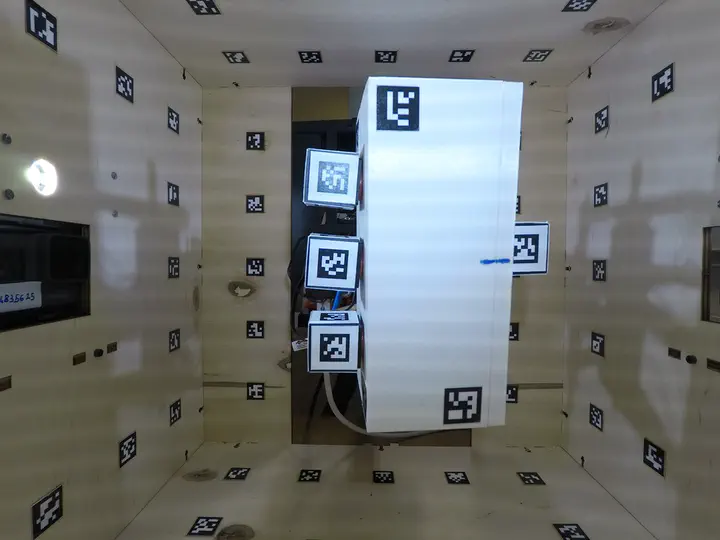
 The proposed system in a frame.
Abstract
Extended Reality, including Virtual Reality, Augmented Reality, and Mixed Reality, enables immersive interaction but still lacks realistic physical behavior in virtual objects, such as mass and weight. In particular, current virtual environments cannot largely represent and simulate intrinsic physical properties such as mass distribution and weight, which are essential for achieving truly immersive and physically consistent experiences. This thesis, developed to assist with some objectives of the EU-funded Social and Human-centered XR project, proposes a system for estimating mass distribution to generate high-quality ground-truth data for learning-based applications. The proposed system integrates both hardware and software components to enable scalable, accurate, and repeatable data acquisition. The hardware setup consists of a multi-camera acquisition box with four calibrated cameras, a passive hand-shaped gripper equipped with force sensors, and a modular 3D-printed object with configurable internal mass distributions. These components are coordinated through a central control unit. The software framework is divided into two modules: a synchronized data acquisition module and a computer vision module. The following performs camera calibration, object pose estimation, and gripper fingertip tracking using fiducial markers, producing precise affine transformation matrices. The system is designed to automate data acquisition for estimating inertial properties, with a focus on accuracy and scalability. Experimental results demonstrate an acceptable baseline of the proposed approach in estimating object and gripper poses and highlight the system’s potential to support learning-based models that incorporate physical properties into virtual environments. This work contributes a solid baseline for data acquisition in XR applications and lays the basis for future research on embedding realistic physical behavior into virtual objects.